

Administrative Stays
A common practice in federal court makes its way to Texas state courts.

I’ll have an argument wrap-up from last week shortly. It was a big week at the Court. Not only was it the final argument week of 2024, with some big cases, but it was Chief Justice Hecht’s final week of argument. He will be retiring at the end of the year, after 36 years on the high court.
Today’s post isn’t about any case. Instead, it’s about a procedural innovation in Texas state courts that has received significantly more use (and attention) at the federal level—administrative stays.
What are administrative stays?
There’s a good chance that if you’re reading this substack you know what an administrative stay is. They have received significant attention for their use in federal court, including at the U.S. Supreme Court. Professor Steve Vladeck has written about them on several occasions on his substack. See, e.g., Bonus 72: Administrative Stays and Justice Barrett's SB4 Concurrence. Professor Rachel Bayefsky has written about them as well. See Administrative Stays: Power and Procedure, 97 N.D. L. Rev. 1941 (2022). But, for those of you less familiar with this device, I’ll provide a brief overview.
Parties looking to stay a district court action pending appeal in a federal court can request a “stay pending appeal.” The court of appeals determines whether to grant the stay based on four factors outlined in Nken v. Holder
(1) whether the stay applicant has made a strong showing that he is likely to succeed on the merits; (2) whether [he] will be irreparably injured absent a stay; (3) whether issuance of the stay will substantially injure the other parties … ; and (4) where the public interest lies.
556 U.S. 418, 426 (2009). The U.S. Supreme Court has a similar standard for parties seeking a stay “pending the filing and disposition of a writ of certiorari.”
To obtain a stay pending the filing and disposition of a petition for a writ of certiorari, an applicant must show
(1) a reasonable probability that four Justices will consider the issue sufficiently meritorious to grant certiorari; (2) a fair prospect that a majority of the Court will vote to reverse the judgment below; and (3) a likelihood that irreparable harm will result from the denial of a stay.
Hollingsworth v. Perry, 558 U.S. 183, 190 (2010). Because both of these analyses require considering the merits of the case and determining harm, the court may need time to decide. The appellant or petitioner may seek, or the court may grant on its own, an “administrative” stay.
While there is no precise definition of these stays, the Ninth Circuit has characterized an administrative stay as a device that is intended to preserve the status quo until the substantive motion for a stay pending appeal can be considered on the merits. See Nat’l Urb. League v. Ross, 977 F.3d 698, 701 (9th Cir. 2020). The administrative stay does not in any way constitute a decision on the merits. Indeed, that is often noted in the order granting an administrative stay. In June Medical Services, L.L.C. v. Gee, the Supreme Court granted an administrative stay
Because the filings regarding the application for a stay in this matter were not completed until earlier today and the Justices need time to review these filings, the issuance of the mandate of the United States Court of Appeals for the Fifth Circuit, case No. 17-30397, is administratively stayed through Thursday, February 7, 2019. This order does not reflect any view regarding the merits of the petition for a writ of certiorari that applicants represent they will file.
139 S.Ct. 661 (2019) (emphasis added). Similarly, the Court in Missouri v. Murthy, the social media censorship case, administratively stayed the district court’s order
UPON CONSIDERATION of the application of counsel for the applicant, IT IS ORDERED that the preliminary injunction issued on July 4, 2023, by the United States District Court for the Western District of Louisiana, case No. 3:22-cv-01213, is hereby administratively stayed until 11:59 p.m. (EDT) on Friday, September 22, 2023. It is further ordered that any response to the application be filed on or before Wednesday, September 20, 2023, by 4 p.m. (EDT).
This stay was interesting and unusual, though consistent with Justice Alito’s practice in other cases, because it identified its expiration at the outset. See also 23A814, United States v. Texas.1 Justice Alito has, however, extended these stays. But these stays often leave litigants wondering how long they will last.
As Justice Barrett noted, the federal courts of appeals use these administrative stays for the same purpose. 144 S.Ct. 797, 798; see, e.g., Brady v. National Football League, 638 F. 3d 1004 (8th Cir. 2011)2.
Put simply, an administrative stay is typically used as a short-term device to give the federal courts time to consider the merits of a motion for a stay pending appeal.
Temporary relief in Texas courts
Texas courts have similar procedures for “temporary relief” pending appeal to a higher court. There are two separate rules in Texas: one addresses temporary relief for appeals and the other for original proceedings (petitions for writ of mandamus). In a mandamus proceeding in the Supreme Court or a court of appeals, “[t]he relator may file a motion to stay any underlying proceeding or for any other temporary relief pending the court's action on the petition.” Tex. R. App. P. 52.10(a). Texas Rule of Appellate Procedure 29.3 operates for a similar purpose in appeals. The rule authorizes the courts of appeals to “make any temporary orders necessary to preserve the parties’ rights until disposition of the appeal and may require appropriate security.” The standard for issuing such relief is unclear. But, in his recent decision, Justice Blacklock provides some guidance3
An appellate court asked to decide whether to stay a lower court’s ruling pending appeal or to stay a party’s actions while an appeal proceeds should seek “to preserve the parties’ rights until disposition of the appeal.” The equitable authority we exercise today, under Rule 52.10, serves the same purpose—preservation of the parties’ rights while the appeal proceeds. A stay pending appeal is, of course, a kind of injunction, so the familiar considerations governing injunctive relief in other contexts will generally apply in this context as well.
In re State (24-0325), at 4–5 (citations omitted). This leads him to conclude that
To begin with, an appellate court can hardly endeavor to preserve the parties’ rights pending appeal without making a preliminary inquiry into what those rights are. Thus, the likely merits of the parties’ respective legal positions are always an important consideration when a court is asked to issue an order determining the parties’ legal rights pending appeal. There is little justice in allowing a party who will very likely lose on the merits to interfere with the legal rights of the opposing party during the appeal, if this can be avoided. Likewise, it may often be unjust to require a party who is very likely to succeed on the merits to wait for the lengthy appellate process to play out before exercising his legal rights.
Id. at 5. As the opinion makes clear, appellate courts asked to grant temporary relief pending an appeal or mandamus must make at least a preliminary inquiry into the merits and the injury that will befall either party, depending on the court’s decision. And these stays are creatures of equity. So these two considerations do not foreclose consideration of other matters. These decisions can take time. And until recently, there wasn’t an alternative procedural device in Texas state court to halt proceedings.
Administrative stays in Texas courts
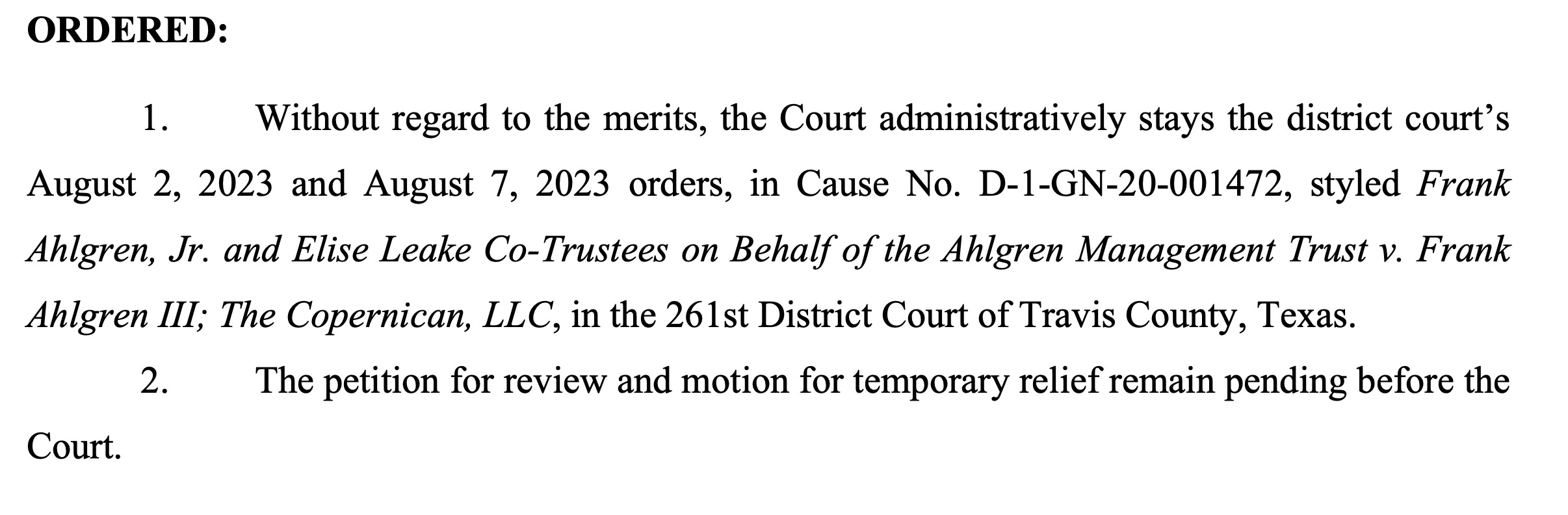
After significant research, combing through the Supreme Court’s orders list and the docket of any case with a stay, and a search of the intermediate courts of appeals’ dockets in TAMES, I discovered that SCOTX first issued an administrative stay on August 14, 2023. That order said
Without regard to the merits, the Court administratively stays the district court’s August 2, 2023 and August 7, 2023 orders, in Cause No. D-1-GN-20-001472, styled Frank Ahlgren, Jr. and Elise Leake Co-Trustees on Behalf of the Ahlgren Management Trust v. Frank Ahlgren III; The Copernican, LLC, in the 261st District Court of Travis County, Texas.
23-0683, Ahlgren v. Ahlgren. The stay lasted two days before the Court denied the petitioner’s motion for emergency relief. Just one week later, the Eleventh Court of Appeals (Eastland) issued an administrative stay. It’s order nicely explained the rationale and the limits of such a stay
Because this court needs sufficient time to review the merits of Appellant’s emergency motion, we issue a temporary stay, effective immediately. See Tex. R. App. P. 29.6 (permitting review of interlocutory orders entered while an interlocutory appeal is pending). The temporary stay order is limited in time; enforcement of the July 21 order is stayed only until further order of this court—after this court has had sufficient time to review the merits of Appellant’s emergency motion to stay and any response filed by Appellee.
Boucher v. Warrior Crane Serv., 11-23-00174-CV, at 2 (Tex. App.—Eastland, Aug. 21, 2023). The Supreme Court of Texas has issued several more administrative stays since Ahlgren:
In re State (23-0994), challenging the trial court order granting a temporary restraining order barring enforcement of the Texas abortion statutes.
In re Elhindi (23-1040), seeking to halt a trial court order to produce a video in discovery that the Relator alleged may contain child sexual abuse material, where production could violate federal law.
In re Richardson (24-0086), a discovery-related mandamus challenging a probate court order to turn over entire hard drives.
In re State (24-0325), challenging the constitutionality of the “Uplift Harris” program, which provided a $500 monthly stipend (a kind of UBI) to a sample of Harris County residents, under the Texas Constitution’s gift clause. Justice Blacklock’s opinion discussed administrative stays in greater depth.
And two additional courts of appeals have issued administrative stays.4
Concluding thoughts
This procedural device has been uncommon since its recent introduction to Texas courts, with only a handful of administrative stays granted throughout the state in the last few years. While Justice Barrett has noted their potential for misuse at the federal level—they are occasionally extended for such a lengthy period as to exceed the “limited” duration for the court to consider the merits—administrative stays are a useful device to give courts additional time to rule on the motions for temporary relief, particularly in mandamus proceedings (which are far more common in Texas state court than in federal court). Given the relative obscurity in Texas practice, appellate lawyers should request an administrative stay in their motions for temporary relief, in addition to stays under TRAP 29.3 and 52.10. With a brief explanation to the court, it may be a beneficial device for emergency situations to avoid overburdening the courts and the original proceedings staff attorneys with urgent deadlines for relief that requires assessment of the merits.
“Order issued by Justice Alito: Upon consideration of the application of counsel for the applicant, it is ordered that the March 2, 2024 order of the United States Court of Appeals for the Fifth Circuit, case No. 24-50149, is hereby administratively stayed until 5 p.m. (EDT) on Wednesday, March 13, 2024. It is further ordered that a response to the application be filed on or before Monday, March 11, 2024, by 5 p.m. (EDT).”
“The motion of appellants National Football League, et al., for a temporary stay of the district court’s order dated April 25, 2011, pending a decision by this court on the appellants' motion for a stay pending appeal, has been considered by the court and is granted. The purpose of this administrative stay is to give the court sufficient opportunity to consider the merits of the motion for a stay pending appeal.”
Justice Blacklock notes that the “status quo” is a confusing and unhelpful concept. He suggests that the language of TRAP 29.3, preserving the parties’ rights, is more helpful for courts to understand the appropriate course of action.
The Eighth Court of Appeals in El Paso issued a stay with nearly identical language. See TAC Total Automation Controls, INC. v. MSC Industrial Supply, 08-24-00150-CV, at 1-2 (Tex. App.—El Paso, June 25, 2024). The First Court of Appeals in Houston issued an administrative stay in a mandamus proceeding several months later. See In re Halliburton Manufacturing Center, 01-24-00752-CV, (Tex. App.—Houston [1st Dist.], Oct. 7, 2024). Interestingly, in contrast to the other administrative stays, this one was issued with the authorization of a single judge. As noted above, SCOTUS can and will do the same. That happens when an application is made for a stay to the “Circuit Justice” and is not referred to the full Court for consideration.